+86-18961180163


- All
- Product Name
- Product Keyword
- Product Model
- Product Summary
- Product Description
- Multi Field Search
Views: 0 Author: Site Editor Publish Time: 13-11-2025 Origin: Site
As modern agriculture continues to evolve, hydroponic greenhouse systems have become one of the most efficient and sustainable ways to produce fresh vegetables, fruits, and herbs year-round. Unlike traditional soil-based cultivation, hydroponics allows crops to grow in a controlled environment using nutrient-enriched water. This method maximizes yield, reduces water consumption, and ensures consistent quality—making it the preferred choice for commercial greenhouse growers worldwide.
At Top Greenhouse, we specialize in designing and building advanced hydroponic greenhouses that integrate high-tech climate control, irrigation, and nutrient delivery systems. With years of construction experience, our engineering team has implemented a wide range of hydroponic systems tailored to crops such as lettuce, strawberries, tomatoes, and leafy greens.
In this article, we explore the top 8 hydroponic systems widely used in commercial greenhouse farming today. Each system offers unique benefits depending on crop type, space utilization, and investment scale.

The DFT (Deep Flow Technique) hydroponic system is a hybrid innovation that merges the strengths of Nutrient Film Technique (NFT) and Deep-Water Culture (DWC). It allows plant roots to grow in a deeper, continuously circulating nutrient layer, creating a balanced environment for oxygen, moisture, and nutrition.
This system has gained wide popularity in commercial hydroponic greenhouses for its stability, scalability, and resilience, especially under variable environmental conditions. Top Greenhouse has successfully implemented DFT systems in multiple large-scale vegetable projects across Asia and the Middle East, ensuring reliable year-round production.
A DFT hydroponic system consists of large flat channels or tanks made from food-grade plastic or coated steel. Floating boards—often made from EPS or HDPE—are placed on the surface, each with evenly spaced holes to hold the plants. The nutrient solution fills the tank to a depth of 5–10 cm, allowing roots to remain partially submerged while maintaining contact with oxygen-rich air above.
Nutrient solution is continuously pumped through the tanks from a main reservoir, ensuring a consistent flow and temperature balance. Air pumps or diffusers introduce oxygen, keeping the water aerated and roots healthy.
Unlike NFT systems that rely on a very thin nutrient film, DFT maintains a deeper water layer, which acts as a nutrient buffer during power interruptions. This feature makes it exceptionally reliable for large commercial installations, where system stability is critical.
High stability: Deep water layer prevents root drying during power cuts.
Uniform temperature: Water mass regulates heat, reducing stress on crops.
High yield: Suitable for fast-growing crops like lettuce, basil, pak choi, and celery.
Scalable: Can be expanded across multiple greenhouse bays with centralized nutrient management.
Low maintenance: Minimal clogging and fewer moving parts compared to NFT systems.
Top Greenhouse integrates DFT systems with advanced climate control, CO₂ enrichment, and automatic nutrient dosing systems. Each greenhouse is equipped with PLC and IoT monitoring, allowing real-time adjustments to EC, pH, temperature, and oxygen levels.
The system can also be paired with cooling pads and exhaust fans to maintain optimal microclimate conditions—ensuring consistent production regardless of season or region.
Case Study: 5-Hectare Leafy Vegetable Hydroponic Greenhouse, Southeast Asia
Top Greenhouse designed and constructed a 5-hectare DFT hydroponic greenhouse dedicated to lettuce, spinach, and Asian greens. The facility includes automated nutrient mixing tanks, a centralized irrigation system, and floating raft channels capable of holding over 500,000 plants per cycle.
Through this project, the client achieved:
35% increase in water-use efficiency compared to traditional systems.
Continuous year-round production with stable temperature and nutrient control.
Shorter growth cycles—harvest every 25–30 days.

At Top Greenhouse, DFT hydroponic systems are the preferred choice for commercial vegetable projects requiring reliability, scalability, and automation. They are ideal for lettuce, herbs, and leafy greens in both temperate and tropical climates. With proven success in large-scale operations, Top Greenhouse continues to deliver professional, energy-efficient hydroponic solutions tailored to each client’s business goals.
The pipeline hydroponic system—often referred to as the Nutrient Film Technique (NFT)—is a proven and scalable method widely used in commercial greenhouse vegetable production. It consists of a network of interconnected pipelines where a continuous, thin film of nutrient-rich solution flows along the plant roots, ensuring efficient oxygen and nutrient uptake.
This method is particularly favored by professional growers due to its simplicity, recyclability, and adaptability to both horizontal and vertical installations.
Pipeline hydroponics typically uses PVC or food-grade plastic channels equipped with net pots, nutrient inlets, and drainage points. The design allows uniform water flow and precise control of nutrient concentration. The lightweight materials make it easy to install in both fixed and movable greenhouse benches.
A pump circulates the nutrient solution from a storage tank to the upper end of each pipe. The solution forms a thin film that passes over the roots, then returns to the reservoir for recirculation. This closed-loop circulation maintains nutrient balance and eliminates water waste, achieving a high level of sustainability.
At Top Greenhouse, pipeline hydroponic systems are fully compatible with automated greenhouse controls. By integrating pH sensors, EC meters, and nutrient dosing pumps, growers can remotely monitor and adjust the growing environment. This data-driven approach ensures uniform growth and boosts overall productivity.
Top Greenhouse frequently applies pipeline hydroponics in commercial leafy vegetable projects and educational demonstration facilities. Whether installed horizontally for stability or vertically for space-saving, it remains one of the most efficient methods for achieving high-density, high-yield greenhouse farming.
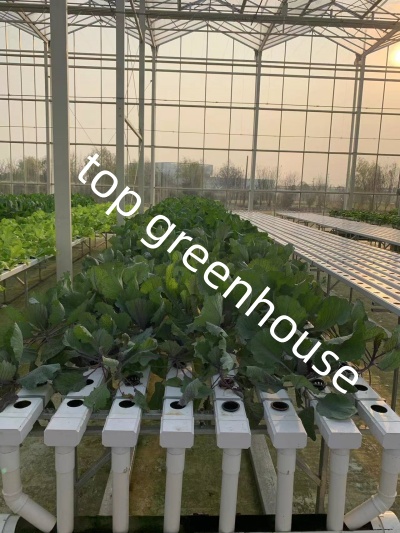
Wall hydroponics, sometimes referred to as living wall hydroponics or vertical panel farming, represents a blend of aesthetic design and agricultural efficiency. This system utilizes vertical walls to cultivate plants, transforming greenhouse structures into productive green surfaces. It maximizes space while maintaining a clean, high-tech appearance—perfect for urban or limited-space greenhouses.
Wall hydroponic systems are built using modular vertical panels that can be easily mounted on greenhouse frames or partition walls. These panels are lined with felt layers or plant pockets, connected to an automated irrigation network that delivers water and nutrients from top to bottom. The modular format allows flexibility in size, crop type, and design aesthetics.
Nutrient solution is pumped to the top of each wall panel and trickles downward through layers of growing media. The design ensures every plant root zone receives adequate nutrients and oxygen. Unused solution is collected and returned to the reservoir, maintaining a continuous recirculation cycle with minimal water loss.
Wall hydroponics is especially effective for herbs, strawberries, and small leafy vegetables. The vertical layout allows dense planting and easy harvesting. When paired with LED lighting and automated irrigation, it enables year-round production—even in small or urban greenhouses.
At Top Greenhouse, wall hydroponic systems are implemented in urban vertical farms, greenhouse showrooms, and decorative horticultural projects. These installations combine functionality and beauty, demonstrating how hydroponic technology can meet both commercial efficiency and environmental sustainability goals.
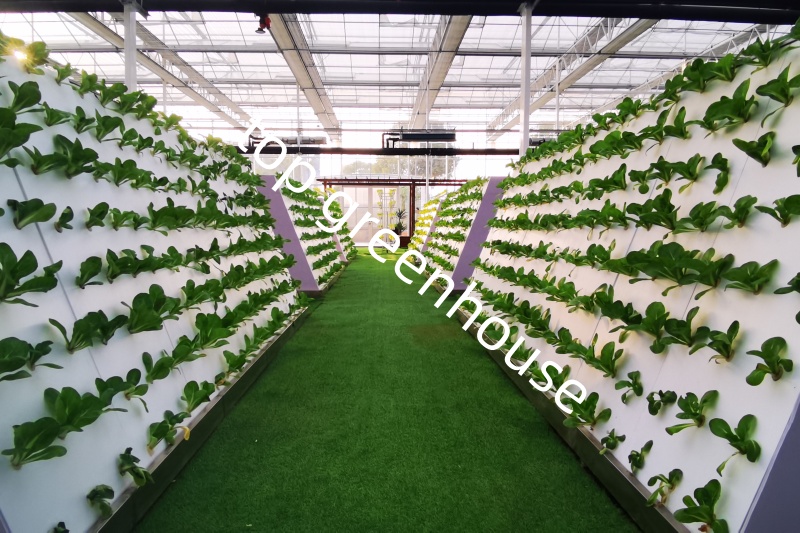
The spiral hydroponic system is a bionic design inspired by natural water flow patterns. It optimizes nutrient circulation and space utilization through a spiral layout that supports a continuous flow of water and nutrients from top to bottom.
Plants are placed along a spiral pipeline that winds downward. Gravity assists the flow of nutrient solution, and the spiral form increases planting density while ensuring even nutrient distribution.
Compact, space-saving, and visually striking design
Low power consumption thanks to gravity-assisted flow
Simplified water and nutrient recycling
Suitable for educational and demonstration greenhouses
Top Greenhouse applies spiral hydroponics in demonstration projects and small-scale commercial setups. It’s an ideal choice for urban farms, hydroponic displays, and research institutions aiming to combine innovation and efficiency.
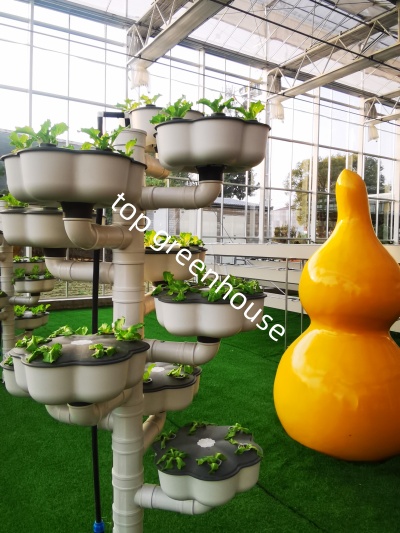
The A-frame hydroponic system is built in a triangular structure, resembling the letter “A.” It enables growers to multiply planting space vertically while maintaining strong structural support and easy maintenance.
Multiple rows of hydroponic channels are installed on each side of the A-frame. A pump delivers nutrient solution to the top, which flows downward through each layer before returning to the reservoir.
Maximizes production per square meter
Highly suitable for strawberries, lettuce, and herbs
Stable frame construction for outdoor or indoor use
Efficient water circulation and minimal nutrient loss
Many commercial strawberry greenhouses built by Top Greenhouse adopt A-frame systems for vertical growth. The design allows sunlight penetration to all levels, leading to higher yields and uniform crop quality.

Aerosol hydroponics, more commonly known as aeroponics, represents one of the most advanced hydroponic technologies available. Instead of water or soil, plant roots are suspended in air and periodically sprayed with a fine mist of nutrient-rich solution.
The system uses high-pressure nozzles to atomize the nutrient solution into tiny droplets. These droplets are absorbed by the exposed roots, providing oxygen and nutrients simultaneously.
Fast plant growth and higher nutrient absorption
Minimal water consumption (up to 90% less than soil farming)
Excellent aeration prevents root diseases
Allows precise nutrient control and automation
Top Greenhouse integrates aeroponic systems into advanced research or high-tech commercial projects where maximum efficiency and data-driven management are required. It’s particularly effective for propagating seedlings and producing high-value crops.

The leaky window hydroponic system is a creative design that mimics the effect of water dripping down a glass pane. It’s both functional and decorative, making it popular in experimental and small-scale commercial greenhouses.
Plants are arranged along a vertical transparent surface or panel. Nutrient solution trickles from top to bottom, resembling a “leaky window.” The roots absorb nutrients as the liquid passes through, and excess solution is collected at the bottom and recycled.
Combines hydroponic function with visual appeal
Excellent for educational or showroom greenhouses
Constant water flow keeps roots oxygenated
Easy to monitor and maintain
At Top Greenhouse, this method is often used in demonstration greenhouses, exhibition halls, and indoor farming projects that emphasize both sustainability and aesthetics.

Floating Capillary Hydroponics (FCH) is an innovative system that relies on the capillary action of materials to deliver nutrients directly to plant roots. The floating boards support plants on the water surface, maintaining constant contact with nutrient solution through capillary wicks.
Roots extend downward from the growing medium into the nutrient solution. The floating board moves slightly as plants grow, maintaining consistent moisture and oxygen levels. This self-adjusting mechanism ensures uniform growth and optimal nutrient uptake.
Simple structure and low energy consumption
Excellent for leafy vegetables, herbs, and seedlings
High water and nutrient utilization rate
Easy to operate and maintain in commercial setups
Top Greenhouse integrates FCH systems into automated hydroponic greenhouses for large-scale lettuce or herb production. Its reliability and adaptability make it an ideal solution for regions focusing on sustainable food production.

With over a decade of experience, Top Greenhouse provides end-to-end hydroponic greenhouse solutions—from structure design and climate control to irrigation automation. Every project is customized according to crop type, climate, and client requirements.
Our hydroponic greenhouses combine efficient cooling, ventilation, shading, and irrigation systems, ensuring optimal growing conditions year-round. Each hydroponic system—whether pipeline, DFT, or aeroponic—can be integrated with automated nutrient dosing and environmental monitoring systems.
Top Greenhouse has completed numerous commercial greenhouse projects across Asia, Europe, and the Middle East. Our team works closely with international growers to deliver reliable, high-performance structures that meet global agricultural standards.
We are committed to promoting sustainable hydroponic farming, reducing water and energy use while boosting productivity. Our goal is to help clients achieve higher returns through modern greenhouse technology.
The future of agriculture lies in innovation, and hydroponic greenhouse systems represent the next step in sustainable food production. From pipeline to floating capillary hydroponics, each method offers unique advantages for different crops and business models.
At Top Greenhouse, we take pride in delivering professional hydroponic farming solutions that combine efficiency, durability, and technology. Whether you are starting a small hydroponic project or expanding into commercial-scale production, our expert team is ready to support you every step of the way.


