Introduction: Why Commercial Greenhouse Design Matters
In today's global agricultural market, commercial growers face mounting challenges. Climate volatility, rising energy prices, labor shortages, and increasing quality standards all put pressure on greenhouse operations to perform more efficiently than ever before. As a result, greenhouse design has evolved from simple shelter construction into a sophisticated engineering discipline.
A modern commercial greenhouse is no longer just a steel frame covered with glass or film. It is a highly integrated production system where structure, ventilation, shading, insulation, and automation work together to create a stable, controllable microclimate. Each design decision directly affects crop yield, energy consumption, operating costs, and ultimately long-term profitability.
This comprehensive guide explains the key elements of
commercial greenhouse design—focusing on structure, ventilation, climate screens, and cost efficiency—and shows how smart design choices can deliver higher yields, lower energy use, and a stronger return on investment (ROI) for commercial growers and investors.
1. Greenhouse Structure: The Backbone of Long-Term Performance
The greenhouse structure forms the foundation of every commercial project. It determines not only strength and durability, but also light transmission, climate uniformity, and the ability to integrate modern environmental control systems.
1.1 Common Types of Commercial Greenhouse Structures
Different greenhouse structures are designed to meet different climate conditions, crop requirements, and investment levels. Choosing the right structure is the first major strategic decision.
Venlo Glass Greenhouse
Venlo-type glass greenhouses are widely recognized as the benchmark for high-tech commercial cultivation. Originating in the Netherlands, this structure has become the global standard for large-scale, intensive production.
Key advantages:
• Light transmission up to 90% with tempered or diffuse glass
• Excellent light uniformity, reducing shading and crop stress
• Strong hot-dip galvanized steel structure
• Modular spans ideal for large greenhouse complexes
• Easy integration of climate screens, ventilation, and automation
Venlo glass greenhouses are commonly used for tomatoes, cucumbers, peppers, leafy greens, flowers, and research facilities. Their superior light performance and climate precision make them ideal for year-round production and high-value crops.
The higher initial investment is typically offset by higher yields, better quality consistency, and longer service life, often exceeding 25–30 years.
Plastic Film Greenhouse (PO Film)
Plastic film greenhouses remain popular in many regions due to their lower construction cost and faster installation.
Key advantages:
• Lower upfront investment
• Flexible structural design
• Quick construction timeline
• Suitable for seasonal or semi-controlled production
PO film greenhouses are often used for berries, leafy vegetables, and nurseries, especially in mild or warm climates. However, film coverings typically require replacement every 3–5 years, increasing long-term maintenance costs.
In addition, film greenhouses generally offer lower insulation and reduced climate stability compared to glass or polycarbonate structures.
Polycarbonate (PC) Greenhouse
Polycarbonate greenhouses provide a middle ground between glass and film, combining durability with improved thermal performance.
Key advantages:
• High impact resistance (hail and wind protection)
• Better thermal insulation than plastic film
• Diffuse light properties that reduce crop stress
• Longer service life than film coverings
PC greenhouses are especially suitable for regions with strong winds, heavy snowfall, or large day–night temperature fluctuations. While light transmission is slightly lower than glass, improved insulation can significantly reduce heating costs in cold climates.
1.2 Structural Design Considerations
Beyond choosing a covering material, the structural design must be tailored to local environmental conditions and long-term production goals.
Key design factors include:
• Local wind, snow, and seismic load standards
• Climate zone and extreme weather risks
• Crop type and cultivation system (soil, hydroponic, vertical)
• Integration of climate screens, vents, and automation
• Drainage, foundation design, and corrosion protection
• Future expansion and modular scalability
A well-engineered structure minimizes risk, ensures stable climate control, and reduces lifetime maintenance costs. Poor structural design, by contrast, can limit system upgrades and significantly increase operating expenses over time.
2. Ventilation Systems: Controlling Temperature and Humidity
Ventilation plays a critical role in maintaining a healthy greenhouse climate. Even the strongest structure and best covering materials cannot compensate for inadequate airflow.
2.1 Natural Ventilation Systems
Natural ventilation relies on pressure differences created by wind and temperature gradients.
Common natural ventilation solutions include:
• Roof ridge vents
• Side wall vents
• Roll-up or lift-up sidewalls
Natural ventilation is highly energy-efficient and works well in regions with stable wind patterns and moderate temperatures. It is often combined with shading screens to improve cooling performance.
However, natural ventilation depends heavily on external weather conditions and provides limited control during extreme heat or humidity.
2.2 Mechanical Ventilation Systems
Mechanical ventilation uses powered equipment to ensure consistent air exchange regardless of weather conditions.
Typical components include:
• Exhaust fans
• Circulation fans (HAF systems)
• Air distribution ducts
• Evaporative cooling systems (wet pad + fan)
Mechanical systems are commonly used in high-density commercial greenhouses and in regions with hot or humid climates. While they require electrical energy, they provide precise and predictable climate control, which is critical for uniform crop development.
2.3 Benefits of Proper Ventilation
An efficient ventilation system delivers multiple benefits:
• Prevents heat stress during peak solar radiation
• Controls humidity and reduces fungal diseases
• Improves CO₂ distribution for photosynthesis
• Enhances uniformity across large greenhouse areas
Poor ventilation often results in uneven growth, higher disease pressure, increased chemical use, and higher energy consumption—directly impacting profitability.
3. Shading and Climate Screens: The Core of Energy Efficiency
Among all greenhouse technologies, climate screens offer one of the fastest and most reliable returns on investment.
3.1 What Is a Climate Screen?
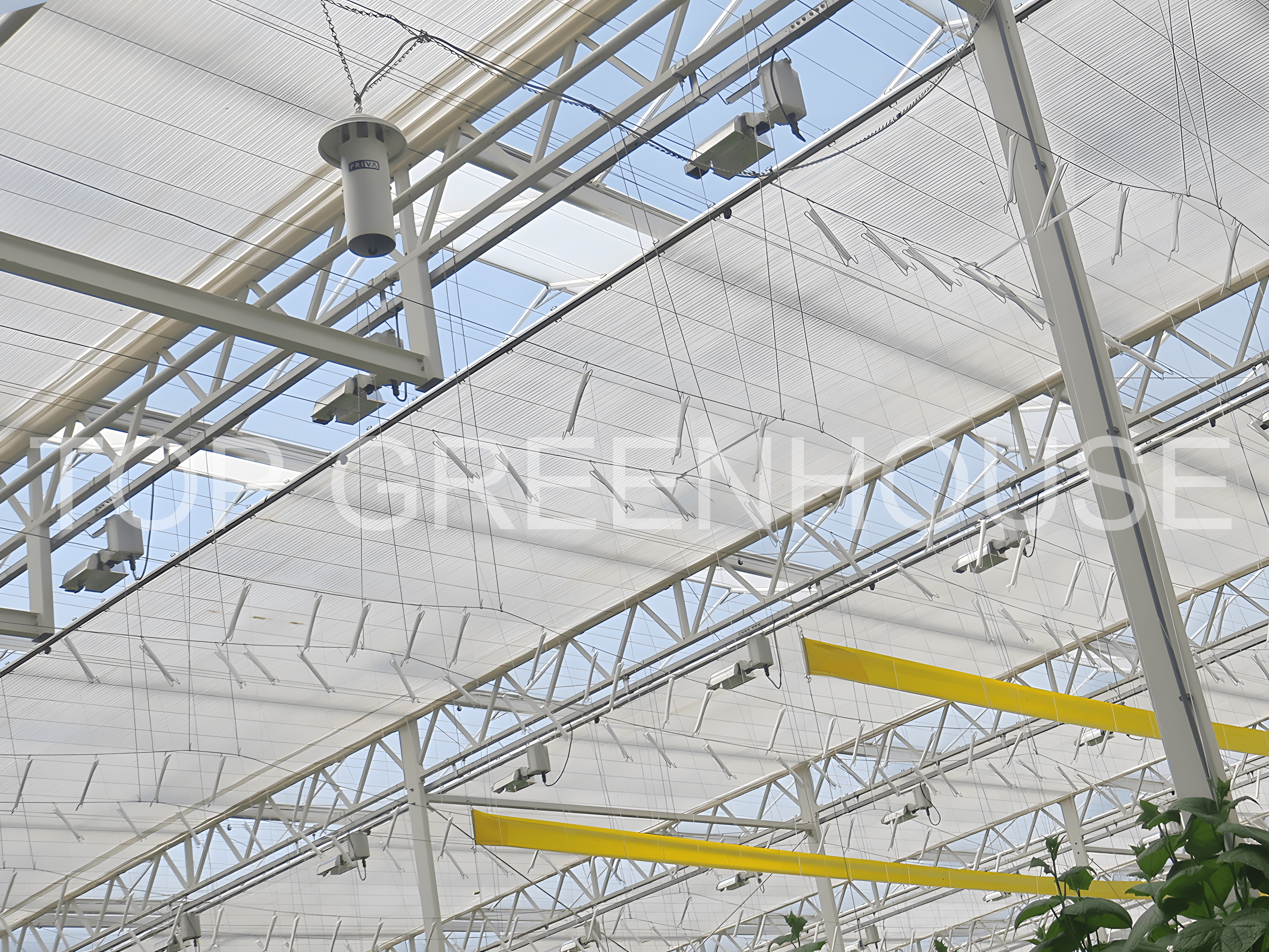
A climate screen is a movable textile system installed inside the greenhouse. It allows growers to dynamically control:
• Light intensity and diffusion
• Heat retention during cold periods
• Solar radiation reduction during hot periods
• Overall energy consumption
Climate screens can be installed in single or multiple layers and are suitable for glass, plastic, and polycarbonate greenhouses.
3.2 Types of Climate Screens
Shading Screens
Shading screens are designed to reduce excessive sunlight during high-radiation periods.
Benefits include:
• Lower daytime temperatures
• Protection against sunburn and leaf stress
• Improved light diffusion for uniform growth
• Reduced cooling demand
External shading reduces heat before it enters the greenhouse, while internal shading offers greater flexibility and protection.
Thermal Screens
Thermal screens are primarily used at night or during cold periods.
Benefits include:
• Reduced heat loss
• 30–50% heating energy savings
• Improved nighttime climate stability
• Faster morning warm-up
Thermal screens are especially important in cold climates or regions with high energy costs.
Energy-Saving Climate Screens
Energy screens combine shading and insulation functions in one system. They are widely used in year-round commercial greenhouses, providing flexible control across all seasons.
3.3 Why Climate Screens Are Essential for Commercial Greenhouses
Compared to increasing heating or cooling capacity, climate screens:
• Require relatively low investment
• Deliver immediate energy savings
• Reduce peak load on HVAC systems
• Improve climate uniformity and crop quality
For modern commercial greenhouse projects, climate screens are no longer optional—they are a standard component of energy-efficient design.
4. Cost Efficiency and ROI: Looking Beyond Initial Investment
Successful greenhouse projects focus on total cost of ownership, not just construction expenses.
4.1 Major Cost Components
Key cost elements include:
• Greenhouse structure and covering materials
• Ventilation, heating, and cooling systems
• Climate screens and control automation
• Installation, maintenance, and labor
While initial investment varies widely by structure type and region, operational costs ultimately determine long-term profitability.
4.2 Smart Cost Optimization Strategies
• Match structure and covering to local climate conditions
• Use climate screens to reduce heating and cooling demand
• Design modular systems for future expansion
• Invest in automation to reduce labor dependency
• Balance upfront cost with durability and lifespan
High-tech commercial greenhouses typically achieve:
• Higher yield per square meter
• Lower energy consumption per unit output
• More stable product quality
• Faster and more predictable ROI
5. Integrated Design: The Future of Commercial Greenhouses
Modern greenhouse design follows an integrated systems approach rather than isolated equipment selection.
In an optimized commercial greenhouse:
• The structure supports efficient ventilation and shading
• Climate screens work in harmony with heating and cooling
• Automation systems continuously adjust the environment
This integration improves sustainability, reduces energy waste, and ensures consistent production throughout the year.

Conclusion: Designing for Performance and Profitability
Commercial greenhouse design is a strategic investment that influences every stage of crop production. By selecting the right structure, optimizing ventilation, and integrating climate screens, growers can significantly reduce operational costs while improving yield and product quality.
A well-designed commercial greenhouse is not merely a construction project—it is a long-term production asset that supports sustainable, efficient, and profitable agriculture in an increasingly competitive market.
© TOP Greenhouse | Sustainable Agriculture & Modern Greenhouse Technology


