+86-18961180163


- All
- Product Name
- Product Keyword
- Product Model
- Product Summary
- Product Description
- Multi Field Search
Views: 0 Author: Site Editor Publish Time: 15-11-2025 Origin: Site
Growing flowers commercially today is no longer just about planting and hoping for favorable weather. As growers, we face unpredictable climate changes, increased disease pressure, unstable rainfall, and intense demand for uniform, high-quality flowers all year round. A multi-span film greenhouse has become an essential tool for professional flower production, not because it is fashionable, but because it creates a controlled environment where every growth factor—from light to temperature and humidity—can be optimized for both yield and quality.
Unlike open-field production, where risks are constant and often uncontrollable, greenhouse flower cultivation provides a protective barrier against extreme heat, heavy rain, frost, and pests. This controlled environment means your output becomes more stable, buyers know what to expect, and your farm becomes a reliable supplier in the market. This shift leads not only to better production consistency but also to greater commercial trust.
Based on our 15 years of professional experience, TOP GREENHOUSE will provide the following reference guidelines from the perspective of a commercial greenhouse manufature.
Investment Planning → Greenhouse Type Decision → Greenhouse Construction → Operational Management → Profitability → Practical Tips
| Content | Description |
|---|---|
| Investment Planning | Plan budget, resources, and investment strategy. |
| Greenhouse Type Decision | Choose the suitable greenhouse type for your crops. |
| Construction | Build and install the greenhouse structure efficiently. |
| Operational Management | Manage daily operations, climate, and irrigation. |
| Profitability | Monitor revenue, costs, and overall returns. |
| Practical Tips | Apply practical advice to optimize performance. |
One of the biggest advantages is stability. Multi-span film greenhouses offer growers the ability to adjust environmental conditions, allowing flowers to grow in optimal conditions regardless of outdoor weather. With proper design, growers can maintain target temperatures, reduce humidity, manage sunlight intensity, and achieve consistent flower development. Predictability is crucial for supplying markets that require uniform stem lengths, stable color intensity, and timely bloom cycles for peak commercial periods.
In a multi-span design, multiple bays are connected under one continuous roof. This creates a large internal space that feels open, airy, and efficient.
Benefits include:
Better airflow across the crop canopy
Easier transportation of materials
Space for mechanical tools (carts, trolleys, irrigation booms)
Lower risk of heat accumulation
For flowers like roses, chrysanthemums, lilies, and gerbera daisies, spacious overhead air volume helps maintain stable microclimates and reduces stress on plants.
Single-span greenhouses or low tunnels are affordable but limited:
Restricted ventilation
Lower headroom
Higher temperature fluctuations
Lower yield uniformity
By contrast, multi-span houses provide a significant performance upgrade without the high cost of a glasshouse. This combination of high performance at moderate cost is the main reason growers prefer film structures.

When planning a greenhouse, you must consider not just the construction cost but also the operational investment. As a grower, the main budgeting questions including:
Which flower varieties am I producing?
Do they require strict climate control?
What is the climate in my region?
How many production cycles per year do I aim for?
Will I sell locally, or is export a goal?
These decisions influence the size and type of flower greenhouse required, from basic structures to advanced automatic systems.
Typically, investment ranges look like this:
| Greenhouse Type | Cost per m² | Cost per 10,000 m² (1 ha) | Description |
|---|---|---|---|
| Basic Multi-Span | $8–25 | $80,000–250,000 | Suitable for mild climates |
| Standard with Cooling + Fertigation | $30–50 | $300,000–500,000 | Ideal for most flower species |
| Fully Automated | $100–300 | $1,000,000–3,000,000 | Necessary for harsh climates or high-end export markets |
This flexibility is why multi-span film greenhouses are popular among small and large growers alike.
The structure is the largest component of the budget. Most growers choose hot-dip galvanized steel for its superior corrosion resistance and long lifespan. Thicker steel is recommended for regions with heavy snow or strong winds. The structure also determines ventilation performance, internal climate stability, and long-term durability.
Choosing the right film is essential. Anti-UV, anti-drop, anti-dust, and light-diffusing films each serve different functions. Diffused film is especially helpful for flowers because it reduces shadowing and improves uniform light distribution, promoting even stem elongation and flower coloration.
Roof and side ventilation are critical for flowers. They regulate temperature, reduce humidity, and allow fresh air exchange. Most professional film greenhouse manufactures prefer electric motor vents for better control, especially in large houses.
Flowers require precise water and nutrient delivery. A good fertigation system improves root health, reduces fertilizer waste, and supports faster growth.
This is one of the most climate-dependent costs.
In hot regions, fan-and-pad cooling is essential.
In cold regions, a heating system is unavoidable.
These include climate controllers, sensor networks, shading systems, and circulation fans. Automation dramatically improves consistency and reduces labor needs.
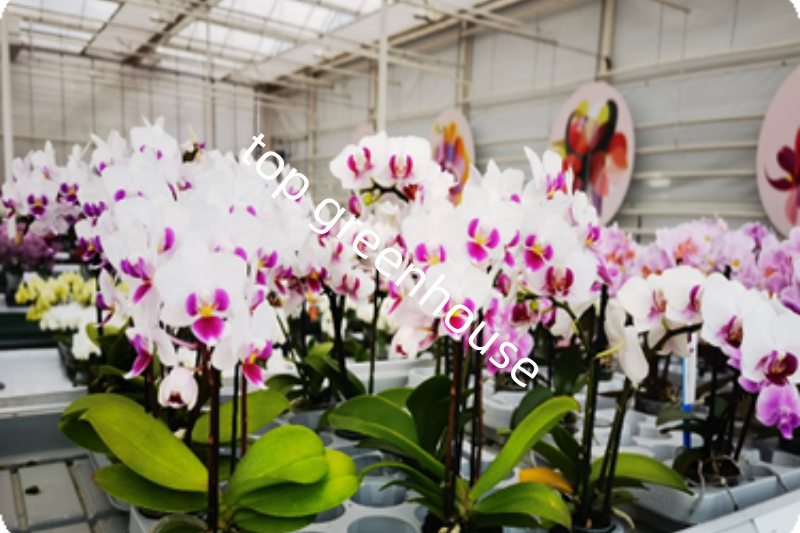
Building a multi-span film greenhouse for flower production is a major investment that requires technical planning, site evaluation, and coordination with experienced engineers. In this section, the construction process is explained from a grower’s perspective, using practical experience from top greenhouse, a professional supplier in commercial greenhouse manufacture. The goal is to help growers understand not only how a greenhouse is built but also why each step matters for long-term productivity and economic return.
Selecting the correct site is the first and most essential step in the entire project. A poor location can increase energy consumption, restrict plant growth, and reduce long-term profitability. A well-selected site, on the other hand, provides a stable foundation for efficient flower production.
Adequate natural light is a critical factor for commercial flower crops such as roses, chrysanthemums, lilies, and gerbera.
A greenhouse should be placed in an area withminimal shadowing throughout the day
The ideal orientation is north–south, allowing even light distribution and avoiding excessive shading during early morning and late afternoon.
Multi-span film structures benefit greatly from uninterrupted sunlight because flowers require consistent light intensity to achieve better color, stem strength, and flowering uniformity.
A professional greenhouse relies heavily on stable utility connections.
The water source must be reliable, clean, and sufficient for irrigation, cooling pads, and fertigation systems.
Electrical power is needed for ventilation motors, circulation fans, irrigation pumps, and automation systems.
Top greenhouse often advises growers to evaluate both water quality and electrical load capacity during the early planning phase, especially for projects involving modern commercial greenhouse manufacture technologies.
Efficient drainage prevents flooding, root disease, and high humidity inside the greenhouse.
Land should be leveled properly before construction.
Drainage channels must be installed around the greenhouse perimeter.
A slope of 0.3%–0.5% is recommended to allow rainwater to drain away naturally.
Good drainage design reduces operational problems and protects the greenhouse structure over time.
A commercial greenhouse depends on regular deliveries of seedlings, fertilizers, substrate, packaging materials, and shipping of finished flowers.
Wide access roads are essential for trucks.
Hard-surfaced paths prevent muddy conditions during rainy seasons.
Site accessibility directly influences logistics efficiency and overall operating costs.

The structure of a multi-span film flower greenhouse determines durability, ventilation performance, and climate stability. A well-engineered structure ensures years of safe operation, especially in regions with strong winds, heavy rainfall, or high temperatures.
Span width affects internal space, climate distribution, and cost per square meter.
8 m spans are economical and suitable for smaller farms.
10–12 m spans offer better airflow and more space for equipment such as mobile benches and misting lines.
Most large-scale flower growers prefer wider spans because they provide a more stable microclimate.
Section width, also called bay spacing, determines the distance between columns and affects both cost and internal working space.
A 4 m section
is economical and provides strong structural stability, making it suitable for growers in windy or snowy regions.
A 5 m section
offers a more open interior with fewer columns, improving airflow and creating easier movement for workers and equipment. In modern commercial greenhouse manufacture, 4 m spacing fits budget-focused projects, while 5 m spacing is favored by larger flower growers who want greater efficiency and layout flexibility.
Gutter height is one of the key design parameters in commercial flower greenhouse manufacture.
Lower heights reduce construction cost but may trap heat.
Higher gutters (4–5 m) improve natural ventilation and temperature stability.
Top greenhouse typically recommends at least 4 m for commercial flower production to prevent overheating and ensure better pest management conditions.
The roof shape influences snow load resistance, condensation behavior, and light distribution.
Arch roofs are economical and widely used.
Gothic roofs provide better snow shedding and increased interior headroom.
For flower production, Gothic designs often create a more uniform climate and offer stronger structural performance.
Column spacing affects internal layout flexibility and installation of irrigation booms.
Wider spacing improves workflow efficiency.
Narrow spacing is cheaper but reduces open floor space.
A spacing of 5 m is commonly used in modern multi-span flower greenhouses.

The plastic film is the primary protective layer of a multi-span greenhouse. Proper installation ensures optimal light transmission and long-term durability.
Film must be stretched evenly across the structure.
Wrinkles can reduce light transmission and shorten film lifespan.
Loose film increases wind damage risks.
Top greenhouse technicians recommend installing film during cooler hours of the day to maintain ideal elasticity.
For commercial flower production, choosing the right film type is essential.
Anti-drip film reduces condensation and prevents water droplets from falling onto leaves or petals.
Diffused film distributes light more evenly, reducing leaf burn and improving photosynthesis.
These materials are widely used in advanced commercial flower greenhouse manufacture projects worldwide.
High-quality ventilation is the simplest and most energy-efficient way to manage temperature inside the greenhouse.
Roof vents are the primary exit point for hot air.
A venting area of 15–25% of the roof ensures stable airflow.
Automated vent systems provide precise climate control.
Growers in warm climates often opt for larger vent areas to prevent excessive heat buildup.
Side vents allow cooler air to enter the greenhouse.
They work together with roof vents to create a natural air-exchange cycle.
In regions with strong wind, insect nets must be added to prevent pest intrusion.
Electric motors improve operational efficiency and accuracy.
Automated systems adjust vent openings based on temperature and humidity.
Integrated controls are becoming standard in modern greenhouse projects.
Flower crops are extremely sensitive to temperature. Proper cooling and shading protect plants from heat stress and improve blooming quality.
In hot climates, evaporative cooling is essential.
Cooling pads absorb water and lower the temperature of incoming air.
Exhaust fans pull cool air across the greenhouse, creating a uniform environment.
This system is commonly used in advanced commercial greenhouse projects supplied by top greenhouse.
Shade nets reduce solar radiation during peak hours.
They prevent leaf burning and reduce heat load by 20–60%.
Retractable shading systems allow dynamic climate control without affecting light quality.
Combining diffused film with internal or external shading improves flower color, stem thickness, and uniformity.
Internal shading provides better climate precision.
External shading offers stronger heat reduction.
Maintaining the right climate is essential for healthy flower production. Each crop has its preferred temperature range:
Roses: 16–28°C
Gerbera: 18–25°C
Chrysanthemums: 15–25°C
Carnations: 12–22°C
Keeping humidity between 60–75% helps prevent fungal diseases and keeps leaf surfaces dry. Good ventilation, shading, and cooling systems work together to stabilize these conditions in multi-span greenhouses.
A reliable fertigation system ensures consistent nutrient delivery and reduces waste. Key benefits include:
Stable EC and pH, helping roots absorb nutrients efficiently
Lower fertilizer consumption through precise dosing
Cleaner, healthier root zones that reduce disease risks
Faster and more uniform plant growth across the entire greenhouse
Multi-span layouts also allow even irrigation distribution, improving overall crop consistency.
Multi-span greenhouses are designed for smooth workflow. The wide interior and fewer obstacles allow:
Easy movement of workers, carts, and tools
Better use of mechanized equipment such as spraying booms or rolling benches
Higher planting density without sacrificing access
Faster, more organized harvesting and daily maintenance
This structure reduces labor hours and increases overall efficiency.
Preventing pests and diseases is easier with proper greenhouse management. Effective methods include:
Insect-proof nets to block common pests
Sticky traps for monitoring and early detection
Climate control, especially humidity management, to reduce disease pressure
Biological control insects, such as predatory mites or parasitic wasps
Improved airflow, which keeps the environment dry and reduces fungal growth
A well-managed multi-span greenhouse creates a healthier growing environment and lowers the need for chemical treatments.
Multi-span greenhouses manufactured provide steady, reliable production. Roses can reach 200–320 stems per m² per year, while chrysanthemums and other flowers offer predictable cycles that fit market demand. With stable climate control, growers achieve better stem length, color, and uniformity—key factors that boost selling price.
Most growers recover their greenhouse investment within 1.5–3 years. ROI depends on local climate, technology level, and crop selection. High-value flowers like roses and gerbera deliver faster returns, especially when paired with efficient irrigation, ventilation, and consistent market access.
Profitable sales channels include wholesalers, florists, online bouquet shops, and event planners. Export markets are also attractive for growers near logistics hubs. Diversifying between these channels helps stabilize income and reduces reliance on a single buyer group.
Multi-span houses are modular—you can expand by adding new spans or connecting additional blocks.
At Top Greenhouse, we know that healthy flowers start with the right environment. Here are some simple tips to save costs, increase yields, and avoid common mistakes.
Start with natural solutions. Good ventilation often reduces the need for expensive cooling systems. Using diffused films spreads light evenly and lowers shading needs. Begin with manual shading or irrigation, then upgrade gradually to automated systems as your operation grows.
Stable conditions lead to stronger, more vibrant flowers. Keep humidity under control, use circulation fans to prevent disease, and maintain consistent nutrient levels. Proper pruning and spacing help flowers grow evenly and improve airflow. Adding reflective surfaces or light-colored floors can also increase light efficiency and flower quality.
Watch out for over-ventilation during the hottest hours, poor drainage, or incorrect film installation. Invest in basic climate sensors to monitor temperature and humidity—they help prevent problems before they harm your plants. Rotating crops or introducing companion plants can also reduce pest pressure naturally.
By combining these strategies—efficient costs, higher yield, and careful monitoring—you can create a healthier, more productive greenhouse. At Top Greenhouse, we provide not only high-quality structures but also practical advice to help your flowers flourish every season.
Building a multi-span film greenhouse is one of the most impactful investments a grower can make. It offers the ability to stabilize production, improve flower quality, and expand into higher-value markets. With proper planning and management, a well-designed greenhouse becomes a long-term asset that delivers strong returns, year after year.
Whether you are starting fresh or upgrading from traditional field growing, a multi-span greenhouse provides the reliability and control needed to thrive in modern commercial flower farming.


