+86-18961180163


- All
- Product Name
- Product Keyword
- Product Model
- Product Summary
- Product Description
- Multi Field Search
 |


TOP
Aluminum, Galvanizing Steel
PE Film, PO Film
OEM, OED
ISO
China
| Quantity: | |
|---|---|
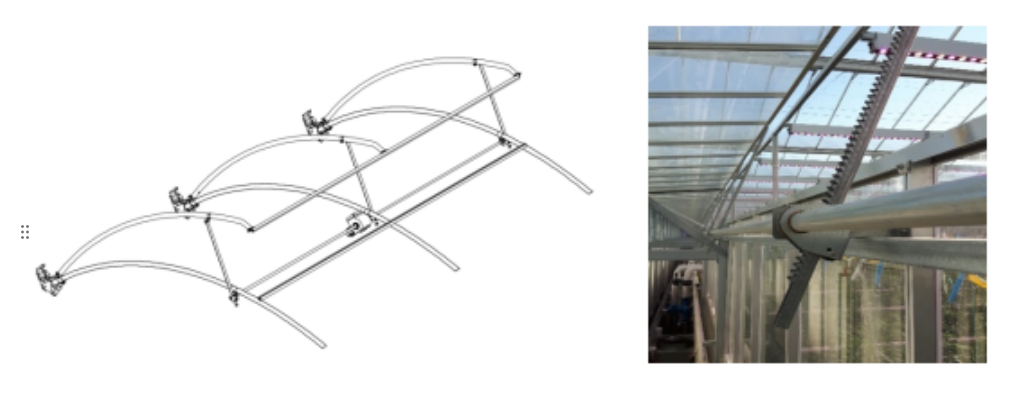
Roof large ventilation windows are major ventilation openings installed along the ridge of a plastic film greenhouse. Their primary function is to release excess heat, humidity, and CO₂ that accumulate at the top of the structure, ensuring a stable growing climate inside the greenhouse. Compared with side vents or small roof vents, large roof vents offer a much larger opening area and significantly higher air-exchange efficiency, allowing hot air to escape quickly through natural convection. These vents are usually operated by rack-and-pinion and can be integrated with climate control systems to automatically adjust ventilation based on temperature, humidity, and wind speed. This design provided by TOP GREENHOUSE greatly improves climate stability, reduces energy consumption, and enhances crop performance in commercial greenhouses.
Large roof vents are essential in areas where summer temperatures frequently exceed 30°C, such as the Middle East, Central Asia, Southeast Asia, and Africa. Since hot air naturally rises, providing a wide rooftop opening allows heat to escape several times faster than through side ventilation alone. This prevents overheating, protects crops from heat stress, and improves overall greenhouse climate balance.
Vegetables like tomatoes, cucumbers, peppers, and strawberries demand continuous air movement to maintain optimal humidity and CO₂ balance. Large roof vents help lower disease pressure—especially gray mold and downy mildew—by reducing humidity peaks and promoting consistent airflow, which enhances photosynthesis and yield quality.
In regions where electricity is expensive or cooling-pad systems increase operational costs, large roof vents can significantly reduce energy use. During moderate seasons, natural ventilation alone can maintain suitable temperatures, lowering the greenhouse’s dependence on forced-air cooling equipment such as exhaust fans.
In valleys, basins, or environments surrounded by buildings where wind speed is low, greenhouses can easily experience stagnant air. Large roof ventilation windows greatly improve natural convection, preventing the “stuffy greenhouse” effect and keeping the internal environment fresh and stable.
※ crop: vegetable and tomato with soil ground cultivation
※ location:Kingdom of Saudi Arabia – Makkah Region
※ climate:desert climate,high temperature,about 15-25℃ in winter,40-50℃ in summer,little rain and abundant sunlight
※ Wind load: 0.40 kN/m² estimated, depend on your local actual factors.
※ Snow load: 0.20 kN/m² estimated, depend on your local actual factors.
※ Design service life: 15 years;
the wind and snow load is for your reference. The final design will be based on the actual data provided by your company.
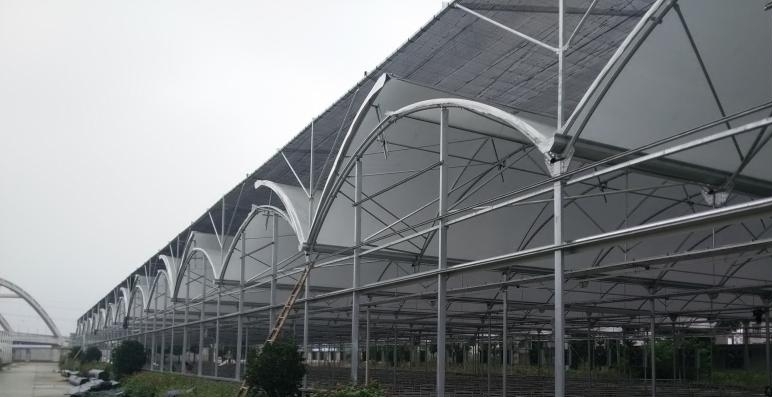
TOP GREENHOUSE design large roof ventilation plastic greenhouse based on the local high temperature,this structure can increase the ventilation and cooling efficiency,
The structure has many advantages such as strong sealing, good ventilation, less shading and less condensation water. It uses flange connection, no welding on site and is easy to disassemble and assemble.
It has high structural strength and strong resistance to natural disasters. The fasteners are made of 8.8 grade hot-dip galvanized standard parts, featuring high strength corrosion resistance. The structure is firmer and more durable,low maintenance, with 15+ years service life.

large roof ventilation plastic greenhouse

large roof ventilation plastic greenhouse
※ span : 9.0m with 5 spans,total 45m width
※ bay: 5.0m with 7 bays, total 35m length
※ gutter height : 4.0m
※ ridge height : 5.8m
※ external screen height:1.5m
※ surface area: 1575㎡
main materials Q235 steel, with the same equal. All the steels are
hot-dip galvanized corrosion protection, factory-customized welded, no welding on site,only need the special flange to connect.
Main materials use hot-dip galvanizing process with the above 1)~3) items,
with a galvanized layer thickness of 250~275 g/m².
※ column
hot-dip galvanized steel
Side column: 100x50x2.75mm; space with 2.5m
Inner column:100x50x2.75mm; space with 5m
gable column: 100x50x2.75mm; space with 9m
※ gutter
hot-dip galvanized steel plates
※ arch
hot-dip galvanized steel,Ø 60x1.5 mm
※ bolts and screws
Hot-dip galvanized bolts and self-drilling screws for connections.
※ Special connection components
aluminized zinc plate with processed and galvanized;

greenhouse special component

greenhouse special component
The aluminum alloy dew collection trough under the steel gutter, the PVC drainage pipes are used to organize the drainage to the flood drainage ditch
1 sliding door with 3.0*3.0m dimension, aluminum frame, polycarbonate panel covered, upper door track
The roof large ventilation is driven by a reduction motor in combination with a rack and pinion .
The large ventilationare located at the top of the arch, which can accelerate the dissipation of heat inside the greenhouse.
Thecondensation gutter discharge the roof condensation water outside the greenhouse, avoid condensate drip and damage crops.
Front overlapping design, open the window, let rainwater in and open the window for ventilation even on light rainy days.
The top window using special wiggle wire channel , good strength, high flatness.
Rarely breakdown and requires minimal maintenance
A film rolling ventilation system is installed around the greenhouse. The height should not be less than 1.8m. Insect nets are set at the window openings, 220V electric film rolling devices, aluminum alloy film rolling rod.
Large roof vents are a core component of an efficient greenhouse ventilation solution, because they use the natural principle that hot air rises. By installing ventilation openings at the highest point of the structure, the greenhouse can release heat rapidly, preventing temperature spikes during hot seasons. This approach is more effective than relying solely on side vents, helping growers maintain a stable climate without excessive energy use.
Excess humidity is one of the main triggers of fungal diseases. As part of a well-designed greenhouse ventilation solution, roof vents provide a direct outlet for humid air to escape. This reduces condensation, lowers the chance of gray mold or downy mildew, and creates a healthier environment for crops. Better humidity control also minimizes the need for chemical treatments.
Large roof vents increase the overall air-exchange capacity of the greenhouse. Fresh air enters from the sidewalls while warm air exits from the roof, creating a steady vertical airflow pattern. This improves CO₂ distribution throughout the crop canopy, supports strong photosynthesis, and leads to higher yields and better-quality produce.
By dramatically improving natural ventilation, roof vents can reduce or delay the need for cooling pads and exhaust fans. This is especially valuable in regions where electricity costs are high. Natural airflow lowers the greenhouse’s energy consumption and operational cost while maintaining a comfortable environment for crops.
In wide-span or high-ridge structures, small vents are often insufficient to move air through the entire growing space. Large roof ventilation windows ensure that air circulates evenly from top to bottom, avoiding hot spots and creating a consistent climate across all cultivation areas. This uniformity leads to more predictable crop performance and easier climate management.
In areas with low wind or poor natural airflow, large roof vents play an even more important role. They strengthen air movement and prevent the greenhouse from becoming stagnant or overheated. This makes the entire greenhouse ventilation solution more adaptable to challenging climates and complex site conditions.

Vegetable Greenhouse

Fruit Greenhouse

Flower Greenhouse

Seedling Greenhouse

Aquaculture Greenhouse

Laboratory Greenhouse

Commercial Greenhouse

Restaurant Greenhouse
As a professional greenhouse solution supplier, TOP GREENHOUSE offers a comprehensive “Roof Large Ventilation for Plastic Greenhouse” system designed to optimize climate control and energy efficiency. The system uses large ridge-mounted ventilation windows made of aluminum and galvanized steel, covered with PE or PO film, to enable rapid heat, humidity, and CO₂ evacuation. Compared with side vents or small roof openings, these large vents significantly increase air-exchange efficiency by leveraging natural convection.
From preliminary planning to structural drawings, climate-system configuration, and on-site guidance, TOP GREENHOUSE offers a one-stop service that ensures long-term stability and reliable project performance. The site also highlights successful global projects, demonstrating strong engineering capability and international experience.
A roof large ventilation window is a ridge-mounted opening in a plastic greenhouse designed to release heat, humidity, and CO₂, improving airflow and maintaining a stable climate inside the greenhouse.
They are recommended in hot climates, for crops needing strong air circulation, in large greenhouses, areas with limited wind, or where reducing reliance on mechanical cooling is desired.
By utilizing natural convection, it allows hot and humid air to escape quickly, lowers temperature peaks, reduces humidity, and ensures better CO₂ distribution for optimal photosynthesis.
Vegetables such as tomatoes, cucumbers, peppers, strawberries, and other crops sensitive to heat and humidity benefit from improved airflow and reduced disease pressure.
The structure is made of aluminum and galvanized steel, with PE or PO film covering, ensuring durability, corrosion resistance, and long-term performance.
Yes, TOP GREENHOUSE offers OEM and OED customization based on local climate, crop type, and greenhouse dimensions to optimize ventilation efficiency.
It can be operated using rack-and-pinion mechanisms or film-rolling systems and can integrate with automated climate control systems based on temperature, humidity, and wind speed.
It provides high air-exchange efficiency, reduces energy consumption, prevents overheating, lowers disease risk, ensures uniform climate distribution, and supports healthier crop growth.
The galvanized steel frame can last over 15 years.


