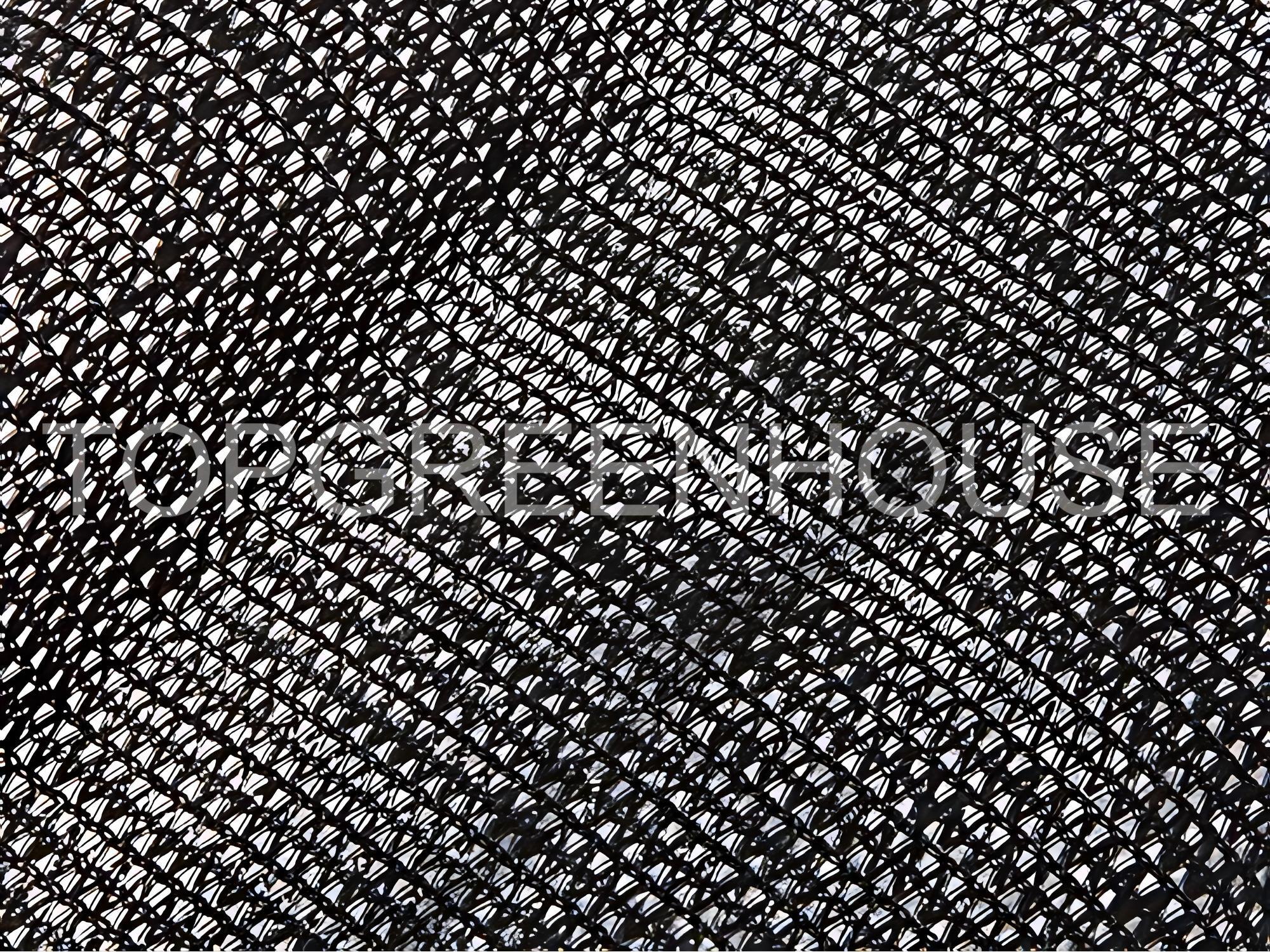
TB50
TOP
Polyester, Polyolefine
OEM, OED
ISO
China
| Availability: | |
|---|---|
| Quantity: | |
Black Screen (Open Structure) is a durable, high-strength shade net for greenhouses and agricultural facilities. Its open-weave design provides insect control, cooling, and protection from rain, hail, frost, and debris. UV-stabilized and low-shrink, it ensures long-lasting performance. Easy to install via rolling, sliding, fixed, or folding systems, this black screen delivers reliable shading, climate control, and year-round crop protection.
Crafted from premium black monofilament, the outer net is exceptionally strong and tear-resistant. It can withstand long-term use in harsh agricultural environments, making it ideal for commercial greenhouses, tunnels, and large-scale crop protection projects.
Integrated UV inhibitors protect the net from sun-induced degradation, preventing brittleness, discoloration, and material aging. This ensures consistent performance even under prolonged exposure to strong sunlight.
In hot summer conditions, the shading net helps lower internal greenhouse temperatures by 3–5°C, improving the growing environment and reducing heat stress on plants.
During winter, the screen minimizes heat radiation escaping from the greenhouse, helping maintain stable temperatures and significantly lowering the risk of frost damage to crops.
Designed to endure extreme weather conditions, including heavy rain, hail, frost, and falling debris. The black outer net acts as a reliable shield, safeguarding both greenhouse structures and crops while reducing maintenance costs.
Enhanced with anti-shrink additives, the net maintains its original dimensions and accurate shading rate over time. Unlike traditional knitted nets, it resists deformation, providing predictable light control for optimal plant growth.
Resistant to acidic and alkaline substances commonly found in fertilizers or greenhouse environments. This makes the net suitable for various agricultural settings and ensures long-term durability without chemical damage.
With long service life, minimal maintenance, and multi-functional protection, the black monofilament outer net is an economical choice for growers seeking reliable, eco-friendly shading and crop protection solutions.
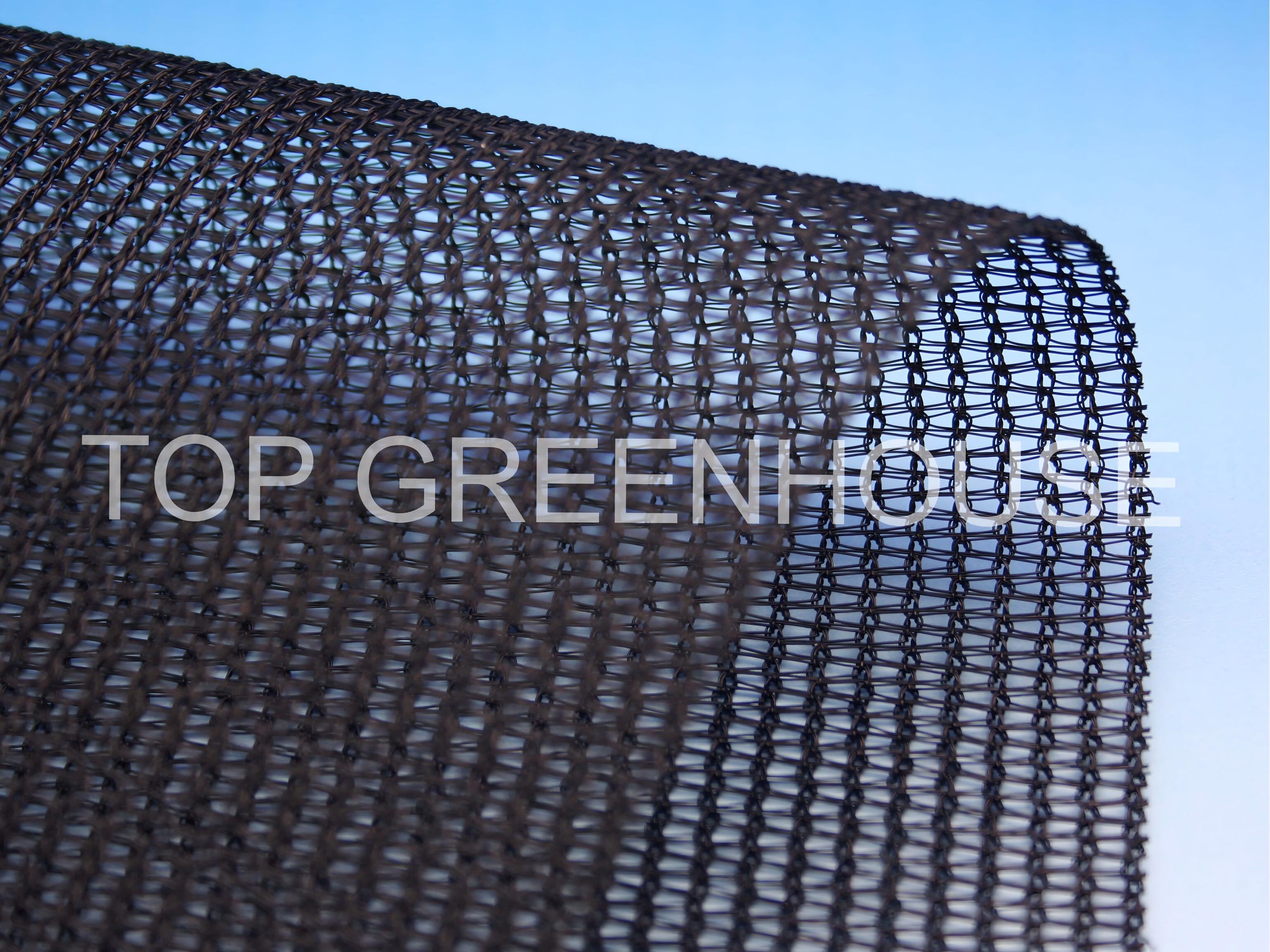
TB80
TBO85
| Model | Material | Light Transmittance (sunny) | Light Transmittance (cloudy) | Shading Rate | Energy Saving Rate |
| TB50 | Polylolefin | 50% | 50% | 50% | 12% |
| TB60 | Polyolefin | 40% | 40% | 60% | 12% |
| TB70 | Polyolefin | 30% | 30% | 70% | 22% |
| TB70 F | Polyolefin | 30% | 30% | 70% | 22% |
| TB80 | Polyolefin | 20% | 20% | 80% | 26% |
| TB80 F | Polyolefin | 20% | 20% | 80% | 26% |
At the heart of this product lies 6-Gauge Warp Knitting Technology, a cutting-edge textile process that combines strength, precision, and flexibility. In this system, yarns are interlaced vertically using six needles per inch, creating a dense and uniform fabric structure. The interweaving of aluminum and PET strips results in a highly durable yet lightweight climate screen with superior mechanical and optical performance.
Warp Knitting Machine
High Structural Accuracy: The even distribution of yarn tension ensures consistent density and excellent dimensional stability across large areas.
Enhanced Durability: The dense knit pattern provides outstanding resistance to tearing, stretching, and deformation, ensuring a long operational lifespan.
Optimized Light Management: Precisely spaced diffusive elements scatter light evenly, promoting homogeneous illumination within the crop canopy.
Energy Efficiency: The reflective aluminum components minimize heat gain during the day and help retain thermal energy at night.
Soft and Easy to Operate: The flexible textile construction folds smoothly and occupies minimal space when retracted.
Fray-Resistant Cutting: The edges remain stable after trimming, allowing easy customization and installation without unraveling.
Secure Material Bonding: PET and aluminum layers are tightly fused to prevent delamination, ensuring reliable performance even in automated climate control systems.
This combination of material engineering and textile precision ensures that each climate screen performs consistently over years of demanding greenhouse use.
Black screens help control heat and excess sunlight in vegetable production. Tomatoes, cucumbers, peppers, and leafy greens grow more uniformly with reduced stress, improved humidity balance, and better protection from sunscald—supporting higher yields and more stable seasonal output.
Ornamentals like petunias, roses, geraniums, and orchids benefit from softer, filtered light. External black screens prevent leaf burn, maintain vibrant colors, and support compact growth. They create predictable conditions that help growers manage flowering cycles and protect high-value decorative plants.
Young citrus, melon, berry, and grape plants thrive with moderated sunlight. Black screens reduce heat stress, prevent tender foliage damage, and protect seedlings from rain, hail, and debris. They create a stable environment that supports strong root development and healthy early growth.
Research facilities use black screens to maintain consistent light and temperature for controlled studies. They reduce external climate fluctuations, support precise environmental management, and integrate easily with automated systems—ensuring reliable conditions for experiments and high-tech cultivation programs.
Every roll of the Transparent Diffuse Energy-Saving Screen is produced in a fully automated weaving and lamination facility. The production process emphasizes consistency and precision—each batch undergoes strict quality checks for material integrity, shading accuracy, and tensile strength. Our in-house testing ensures that every product meets international greenhouse standards for durability, energy performance, and light transmission.
Warpping
Knitting
Testing
Packing
By combining these testing tools, we guarantee that each climate screen meets strict quality standards for energy efficiency, light management, durability, and UV resistance, providing growers with reliable and consistent greenhouse solutions.
To ensure the highest quality and performance of our climate screens, we utilize advanced testing equipment to evaluate all critical aspects of the material:
Measures heat retention and energy-saving efficiency under simulated greenhouse conditions, ensuring optimal performance in both summer and winter.
Analyzes light transmission, diffusion, and spectral distribution to verify that the screen provides uniform illumination and protects crops from excessive radiation.
Assesses the mechanical strength and durability of the screen, including warp and weft resistance, elongation, and load capacity.
Simulates long-term UV exposure to evaluate material degradation, color stability, and performance over time.
Download
Most high-quality external black screens last 5 years, but lifespan varies with UV exposure, local climate, installation quality, and maintenance frequency. UV-stabilized materials and proper tensioning can keep the screen performing well for several seasons without tearing or fading.
Absolutely. The open-structure design helps break raindrops, preventing heavy impact on the greenhouse roof. It also minimizes splashing and erosion around the structure. The mesh dries quickly after rain, reducing moisture-related wear and extending product life.
Yes, they work in colder regions as well. Growers simply choose a lower shading percentage to avoid excessive light reduction during shorter winter days. The screens also provide slight wind buffering and help protect greenhouse roofs from snow or falling branches.
Most modern black screens are engineered for compatibility with automated rolling, sliding, and climate-control systems. They integrate smoothly with sensors that monitor sunlight, temperature, and wind speed—allowing growers to optimize shading without manual adjustments.
Maintenance is simple. Regular inspections for tears, loose stitching, or tension issues, combined with occasional rinsing to remove dust, are usually sufficient. With basic care, black screens maintain strong performance and avoid premature degradation.
Black Screen (Open Structure) is a durable, high-strength shade net for greenhouses and agricultural facilities. Its open-weave design provides insect control, cooling, and protection from rain, hail, frost, and debris. UV-stabilized and low-shrink, it ensures long-lasting performance. Easy to install via rolling, sliding, fixed, or folding systems, this black screen delivers reliable shading, climate control, and year-round crop protection.
Crafted from premium black monofilament, the outer net is exceptionally strong and tear-resistant. It can withstand long-term use in harsh agricultural environments, making it ideal for commercial greenhouses, tunnels, and large-scale crop protection projects.
Integrated UV inhibitors protect the net from sun-induced degradation, preventing brittleness, discoloration, and material aging. This ensures consistent performance even under prolonged exposure to strong sunlight.
In hot summer conditions, the shading net helps lower internal greenhouse temperatures by 3–5°C, improving the growing environment and reducing heat stress on plants.
During winter, the screen minimizes heat radiation escaping from the greenhouse, helping maintain stable temperatures and significantly lowering the risk of frost damage to crops.
Designed to endure extreme weather conditions, including heavy rain, hail, frost, and falling debris. The black outer net acts as a reliable shield, safeguarding both greenhouse structures and crops while reducing maintenance costs.
Enhanced with anti-shrink additives, the net maintains its original dimensions and accurate shading rate over time. Unlike traditional knitted nets, it resists deformation, providing predictable light control for optimal plant growth.
Resistant to acidic and alkaline substances commonly found in fertilizers or greenhouse environments. This makes the net suitable for various agricultural settings and ensures long-term durability without chemical damage.
With long service life, minimal maintenance, and multi-functional protection, the black monofilament outer net is an economical choice for growers seeking reliable, eco-friendly shading and crop protection solutions.
TB80
TBO85
| Model | Material | Light Transmittance (sunny) | Light Transmittance (cloudy) | Shading Rate | Energy Saving Rate |
| TB50 | Polylolefin | 50% | 50% | 50% | 12% |
| TB60 | Polyolefin | 40% | 40% | 60% | 12% |
| TB70 | Polyolefin | 30% | 30% | 70% | 22% |
| TB70 F | Polyolefin | 30% | 30% | 70% | 22% |
| TB80 | Polyolefin | 20% | 20% | 80% | 26% |
| TB80 F | Polyolefin | 20% | 20% | 80% | 26% |
At the heart of this product lies 6-Gauge Warp Knitting Technology, a cutting-edge textile process that combines strength, precision, and flexibility. In this system, yarns are interlaced vertically using six needles per inch, creating a dense and uniform fabric structure. The interweaving of aluminum and PET strips results in a highly durable yet lightweight climate screen with superior mechanical and optical performance.
Warp Knitting Machine
High Structural Accuracy: The even distribution of yarn tension ensures consistent density and excellent dimensional stability across large areas.
Enhanced Durability: The dense knit pattern provides outstanding resistance to tearing, stretching, and deformation, ensuring a long operational lifespan.
Optimized Light Management: Precisely spaced diffusive elements scatter light evenly, promoting homogeneous illumination within the crop canopy.
Energy Efficiency: The reflective aluminum components minimize heat gain during the day and help retain thermal energy at night.
Soft and Easy to Operate: The flexible textile construction folds smoothly and occupies minimal space when retracted.
Fray-Resistant Cutting: The edges remain stable after trimming, allowing easy customization and installation without unraveling.
Secure Material Bonding: PET and aluminum layers are tightly fused to prevent delamination, ensuring reliable performance even in automated climate control systems.
This combination of material engineering and textile precision ensures that each climate screen performs consistently over years of demanding greenhouse use.
Black screens help control heat and excess sunlight in vegetable production. Tomatoes, cucumbers, peppers, and leafy greens grow more uniformly with reduced stress, improved humidity balance, and better protection from sunscald—supporting higher yields and more stable seasonal output.
Ornamentals like petunias, roses, geraniums, and orchids benefit from softer, filtered light. External black screens prevent leaf burn, maintain vibrant colors, and support compact growth. They create predictable conditions that help growers manage flowering cycles and protect high-value decorative plants.
Young citrus, melon, berry, and grape plants thrive with moderated sunlight. Black screens reduce heat stress, prevent tender foliage damage, and protect seedlings from rain, hail, and debris. They create a stable environment that supports strong root development and healthy early growth.
Research facilities use black screens to maintain consistent light and temperature for controlled studies. They reduce external climate fluctuations, support precise environmental management, and integrate easily with automated systems—ensuring reliable conditions for experiments and high-tech cultivation programs.
Every roll of the Transparent Diffuse Energy-Saving Screen is produced in a fully automated weaving and lamination facility. The production process emphasizes consistency and precision—each batch undergoes strict quality checks for material integrity, shading accuracy, and tensile strength. Our in-house testing ensures that every product meets international greenhouse standards for durability, energy performance, and light transmission.
Warpping
Knitting
Testing
Packing
By combining these testing tools, we guarantee that each climate screen meets strict quality standards for energy efficiency, light management, durability, and UV resistance, providing growers with reliable and consistent greenhouse solutions.
To ensure the highest quality and performance of our climate screens, we utilize advanced testing equipment to evaluate all critical aspects of the material:
Measures heat retention and energy-saving efficiency under simulated greenhouse conditions, ensuring optimal performance in both summer and winter.
Analyzes light transmission, diffusion, and spectral distribution to verify that the screen provides uniform illumination and protects crops from excessive radiation.
Assesses the mechanical strength and durability of the screen, including warp and weft resistance, elongation, and load capacity.
Simulates long-term UV exposure to evaluate material degradation, color stability, and performance over time.
Download
Most high-quality external black screens last 5 years, but lifespan varies with UV exposure, local climate, installation quality, and maintenance frequency. UV-stabilized materials and proper tensioning can keep the screen performing well for several seasons without tearing or fading.
Absolutely. The open-structure design helps break raindrops, preventing heavy impact on the greenhouse roof. It also minimizes splashing and erosion around the structure. The mesh dries quickly after rain, reducing moisture-related wear and extending product life.
Yes, they work in colder regions as well. Growers simply choose a lower shading percentage to avoid excessive light reduction during shorter winter days. The screens also provide slight wind buffering and help protect greenhouse roofs from snow or falling branches.
Most modern black screens are engineered for compatibility with automated rolling, sliding, and climate-control systems. They integrate smoothly with sensors that monitor sunlight, temperature, and wind speed—allowing growers to optimize shading without manual adjustments.
Maintenance is simple. Regular inspections for tears, loose stitching, or tension issues, combined with occasional rinsing to remove dust, are usually sufficient. With basic care, black screens maintain strong performance and avoid premature degradation.